

In February 2026, UBS opened a new office in Gachibowli and announced it would hire about 2,000 more people in Hyderabad, doubling its workforce in the city. It was not a bet on the future. It was a decision to grow somewhere that already works.
Decisions like this are never made lightly. A global company expanding into India weighs Hyderabad against Bengaluru, Mumbai, Pune, Chennai and the National Capital Region, and each has real strengths; Bengaluru still hosts more global capability centres (GCCs) than any other Indian city. Yet more and more companies are reaching the same conclusion. Hyderabad is now home to about 515 GCCs, roughly one in five in India, according to a September 2026 study by FICCI and Anarock, and 84 new ones opened there in 2025 alone, according to the state's IT Department.
So what tips the balance? The answer begins with what these companies are actually building.
What Is a Global Capability Centre (GCC)?
A GCC is a company's own office in another country, staffed by its own people and doing its own important work: engineering, analytics, finance and research.
It is not outsourcing. An outsourcing contract can move to a cheaper vendor when it ends. A GCC is much harder to move, because it is built on years of hiring, training and long leases in the company's own name. That gives us a simple way to read the trend, which we might call the Ownership Test: outsourcing tells you which vendor a company trusts, but a GCC tells you which city it is willing to commit to.
By that test, a growing number of companies have chosen to trust Hyderabad. Here is what they see.
Hyderabad's Talent Pool: The First Test
Every GCC begins with people. A centre of a few thousand cannot be staffed from abroad; it needs a city where skilled managers, engineers and specialists already live and work. When one global bank explained its recent expansion here, its India operations head put the city's talent pool first, alongside supportive policies and strong infrastructure.
The urbanist Jane Jacobs observed that cities grow by adding new kinds of work to the work they already do. Hyderabad is a good example. Two decades of IT services built a workforce that understands how global companies run, and today more than 3 lakh professionals work in the city's GCCs. A company arriving now can hire people who have done this before, rather than training everyone from scratch.
How Hyderabad Compares with Other Cities
Talent alone does not settle the choice, because Bengaluru and, more recently, Pune have deep talent too. So companies compare the practical details.
Cost usually comes first. Prime office space in Hyderabad rents for ₹95 to ₹115 per sq ft a month, according to FICCI and Anarock, while prime rents in Bengaluru reached ₹163 in mid-2026, according to Knight Frank. Over many years and a large team, that difference adds up.
Availability comes next. Hyderabad's office vacancy stood at 11.8% in the third quarter of 2026, according to Knight Frank, and NAREDCO Telangana, the developers' body, says even a requirement of one lakh sq ft can be met readily. A company can move into a finished building instead of waiting for one to be built.
Then there is everyday life. NAREDCO Telangana points to Bengaluru's traffic and water shortages as concerns for employers deciding where to place thousands of people.
None of this makes the other cities a poor choice. Pune, for one, took a slightly larger share of India's GCC office leasing than Hyderabad in 2025, according to FICCI and Anarock. Pune and Chennai can also make a fair case on cost and space. What truly sets Hyderabad apart lies elsewhere.
Beyond IT: The Industries Setting Up GCCs in Hyderabad
The first difference is that Hyderabad has become a leading home for whole industries, not just for IT. Core software and technology now account for about 28% of incoming GCC investment, according to Telangana government data. The rest comes from banking, life sciences, semiconductors, defence and consumer goods.
Banking and finance lead the way. More than half of all new banking and finance GCCs set up in India chose Hyderabad, according to Nasscom's GCC Landscape Report 2026. Western Union, which opened a centre of around 400 employees in January, is one of them.
Life sciences tell a similar story. According to JLL, nine of the world's 18 largest healthcare, pharmaceutical, biotech and medical device companies have operations in Hyderabad, among them Novartis, Sanofi, Eli Lilly and Amgen, and pharmaceutical companies took 30% of GCC office leasing in the city in 2024. Genome Valley, India's first organised life sciences cluster, surrounds them with a scientific community few cities can offer.
Even consumer brands are arriving. In April 2026, Heineken opened its first multi-function business services hub in Asia in Hyderabad's Financial District, starting with about 300 people and planning for 1,600. Its senior director, Ákos Magyari, pointed to the city's depth in digital, AI and business services. For a company in almost any of these fields, Hyderabad offers something rare: peers from its own industry, already settled nearby.
Why GCCs in Hyderabad Keep Multiplying
The second difference is momentum. Because GCCs are hard to move, they tend to stay and grow where they start. Each one that stays adds experienced people, specialist suppliers and services to the city, which makes the decision a little easier for the next company.
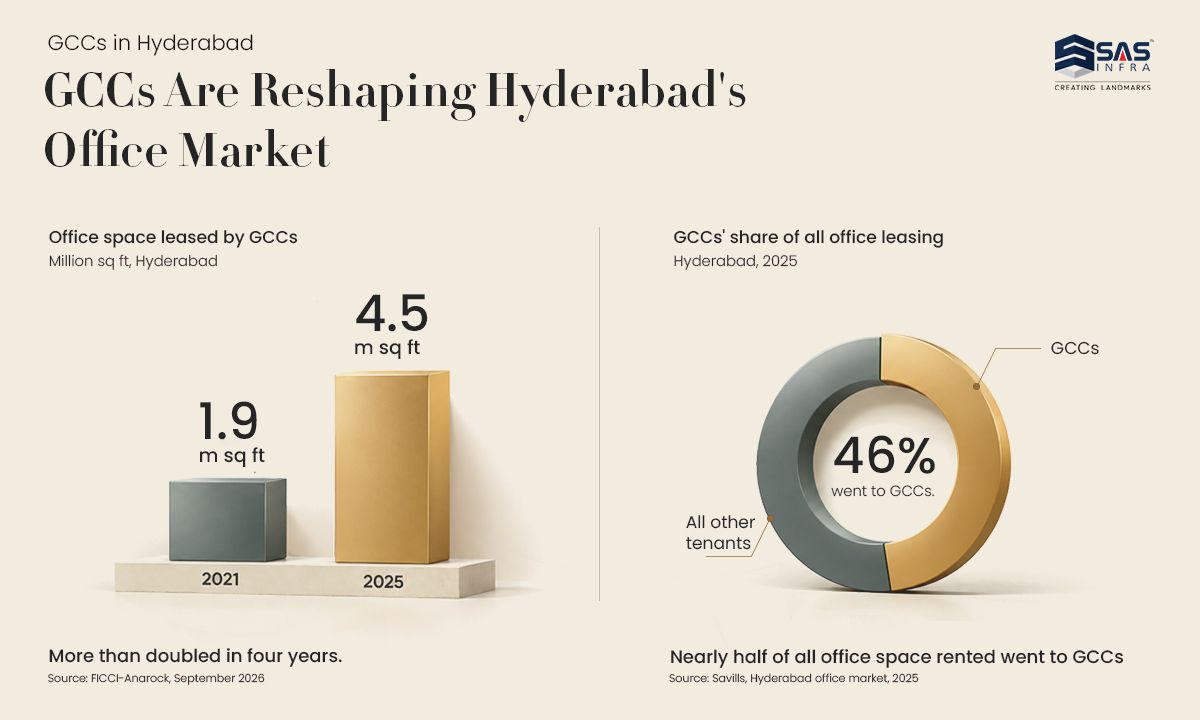
This year's numbers show how quickly that is happening. From January to September 2026, Hyderabad leased 13.1 million sq ft of office space, 50% more than a year earlier, and GCCs took 47% of it, according to Knight Frank. In just one year, the city's share of all GCC office leasing in India rose from 15% to 23%, continuing a climb from 1.9 million sq ft of GCC leasing in 2021 to 4.5 million in 2025, according to FICCI and Anarock.
And every one of these companies needs somewhere to work.
What GCCs Need from an Office Building
The third difference is the buildings themselves. GCCs tend to look for three things: large floors that keep teams together, room to grow without moving, and a workplace good enough to attract and keep talented people.
Hyderabad's western IT corridor, running from HITEC City and Gachibowli to the Financial District and Nanakramguda, is where a new generation of Grade A towers is being built around exactly those needs.
SAS iTower: Built for the GCC Era
SAS iTower in Nanakramguda offers typical floor plates of 1.2 lakh sq ft, the largest in the city: enough for the entire operation of a company with up to 3,000 employees on a single floor. That is what large floors mean in practice: teams working side by side rather than spread across a stack of floors. And with 40 high-speed passenger lifts serving its 37 storeys, moving between floors stays quick and easy.
Floors can also be configured to each company's needs, so a GCC can start with the space it requires today and grow within the same building. That matters more than it first appears. The Ownership Test tells us GCCs plan to stay; iTower lets them stay without the disruption of moving each time they expand.
Getting there is easy, too. The tower sits about seven minutes from the Financial District and fifteen from HITEC City, at the heart of Hyderabad's GCC corridor. Within a development designed for more than 50,000 employees, it brings together food courts, wellness and leisure spaces and a retail destination, and the tower is targeting WELL Silver certification for occupant health alongside LEED Gold. Everything employees need through the working day is close at hand, so they can focus on the work itself.
Why Hyderabad, and Why Now
Bengaluru, Pune, Chennai, Mumbai and the National Capital Region all remain strong choices, and each will keep winning its share. Hyderabad is not the only answer. But it offers a combination that is hard to find in one place: leadership in banking and life sciences GCCs, a share of national GCC leasing that jumped from 15% to 23% in a single year, and office buildings with floors large enough to hold an entire operation.
From UBS and Heineken to Lonza, Zurich Insurance and Southwest Airlines, companies across industries have already found that combination enough to tip the balance. And with every GCC that chooses to stay, the case becomes a little stronger for the next.